Independent research publication · First edition 2026
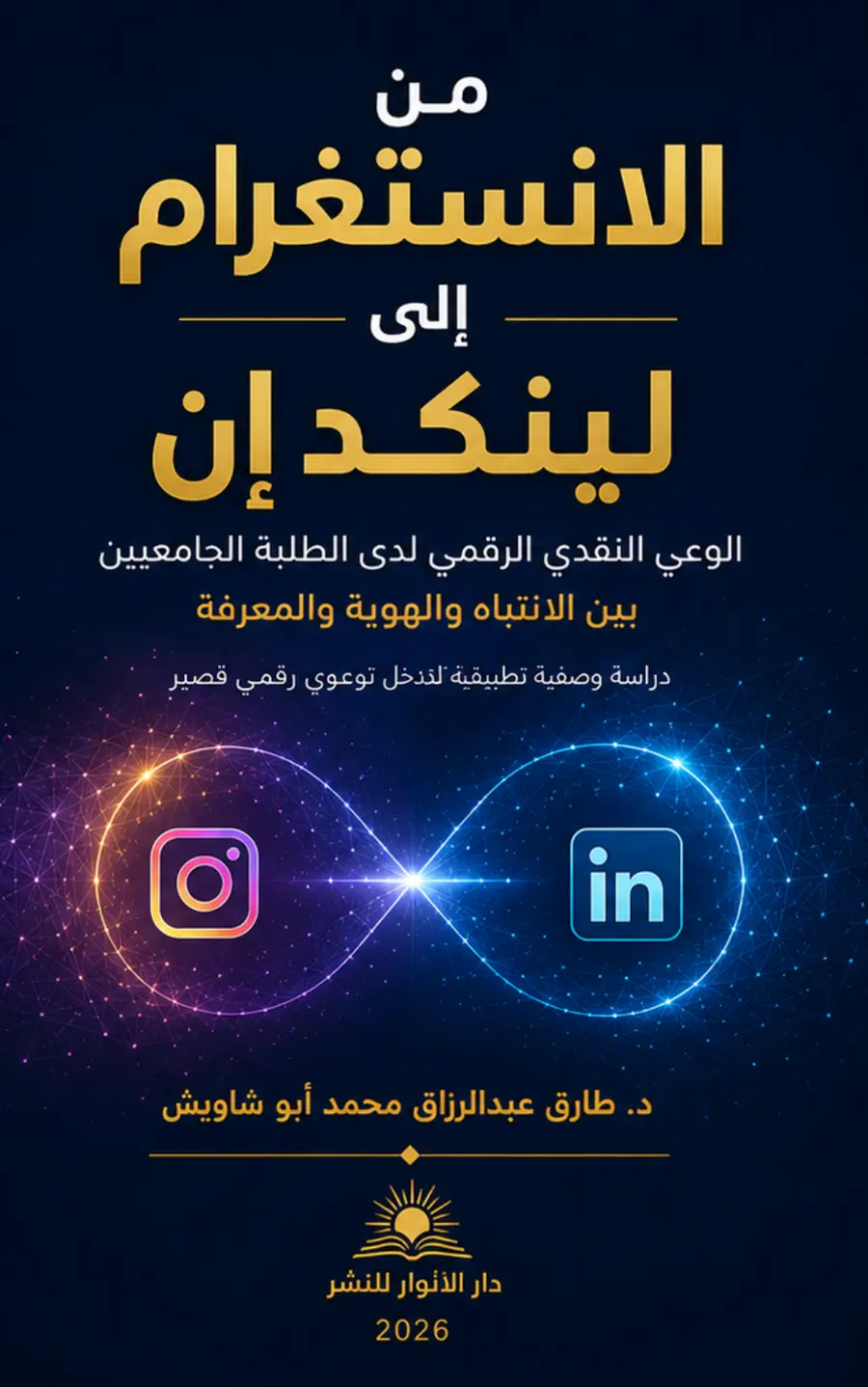
From Instagram to LinkedIn
University students’ perceptions of the impact of digital platforms on attention, identity and knowledge, and the effectiveness of a digital awareness intervention in promoting critical awareness
An applied descriptive study that moves digital-awareness questions from general observation to measurement, then examines indicators following a short awareness intervention grounded in students’ everyday experience.
Final publication · 139 pages · Independent researchRead on the platformWeb reader · no downloadable file
Work summary
Presentation reviewed:
- Work type
- Independent research and digital awareness
- Status
- Study and book published
- Date and scope
- 2026
- Tareq’s role
- Researcher, author and awareness-content developer
- Outputs
- Study, book and related public-awareness content
- Evidence scope
- 96 pre-survey and 40 post-survey responses; unpaired samples
How do university students perceive the effects of platforms on attention, identity and knowledge, and what indicators emerge after a short digital awareness intervention?
Study at a glance
RESEARCH THEMES
Research themes
Attention economy
Intensity of use, the value of time, and the role of design and algorithms in sustained engagement.
Focus and distraction
Continuous feeds, rapid switching and the distraction mindset as an everyday digital experience.
Identity and comparison
Personal and professional presentation, visible success, and the gap between posts and full context.
Credibility and expertise
Distinguishing popularity from accuracy and digital visibility from expertise.
Artificial intelligence
Content origin, transparency, human review and uncertainty around generated media.
Methodology
An unpaired pre/post design with quantitative analysis supported by qualitative indicators.
Pre-survey
An initial survey of 96 university students explored use patterns, perceptions and prior awareness.
Awareness intervention
A short digital series addressed the attention economy, distraction, comparison, credibility and generated content.
Post-survey
A later survey of 40 participants examined immediate awareness and evaluation indicators.
Responsible interpretation
Descriptive analysis within the limits of two unpaired samples, supported by open-ended responses.
Selected findings
High initial awareness, with positive indicators following the intervention.
reported greater awareness that popularity does not equal credibility.
considered this form of awareness useful for university students.
reported greater awareness of platforms’ effects on attention.
selected the distraction mindset as the most influential topic.
These figures are indicators from the post-survey (n=40) and should be read within the limits of the unpaired design.
Integrity and interpretive limits
Published findings without personal data or causal overclaiming.
- The website displays no participant names, identifying details or raw responses.
- The pre- and post-surveys used unpaired samples, so findings are indicators rather than conclusive causal proof.
- Percentages are presented in the context of sample size, instruments and study limitations.
- The full publication contains the theoretical framework, methodology, references, instruments and appendices.
From research to impact
Research
Question, instrument and analysis
Book
Independent publication
Podcast
Questions that open discussion
Practice
Awareness, tools and decisions
FROM IDEAS TO PRACTICE
Want to explore these ideas with your students or team?
A practical workshop on attention, credibility and conscious platform use, with examples and exercises suited to your audience.